
Better late than broken
Jasprit Bumrah's injury history reveals one clear pattern: patient rehabilitation has produced his best cricket, while the only rushed comeback in 2022 ended in relapse.

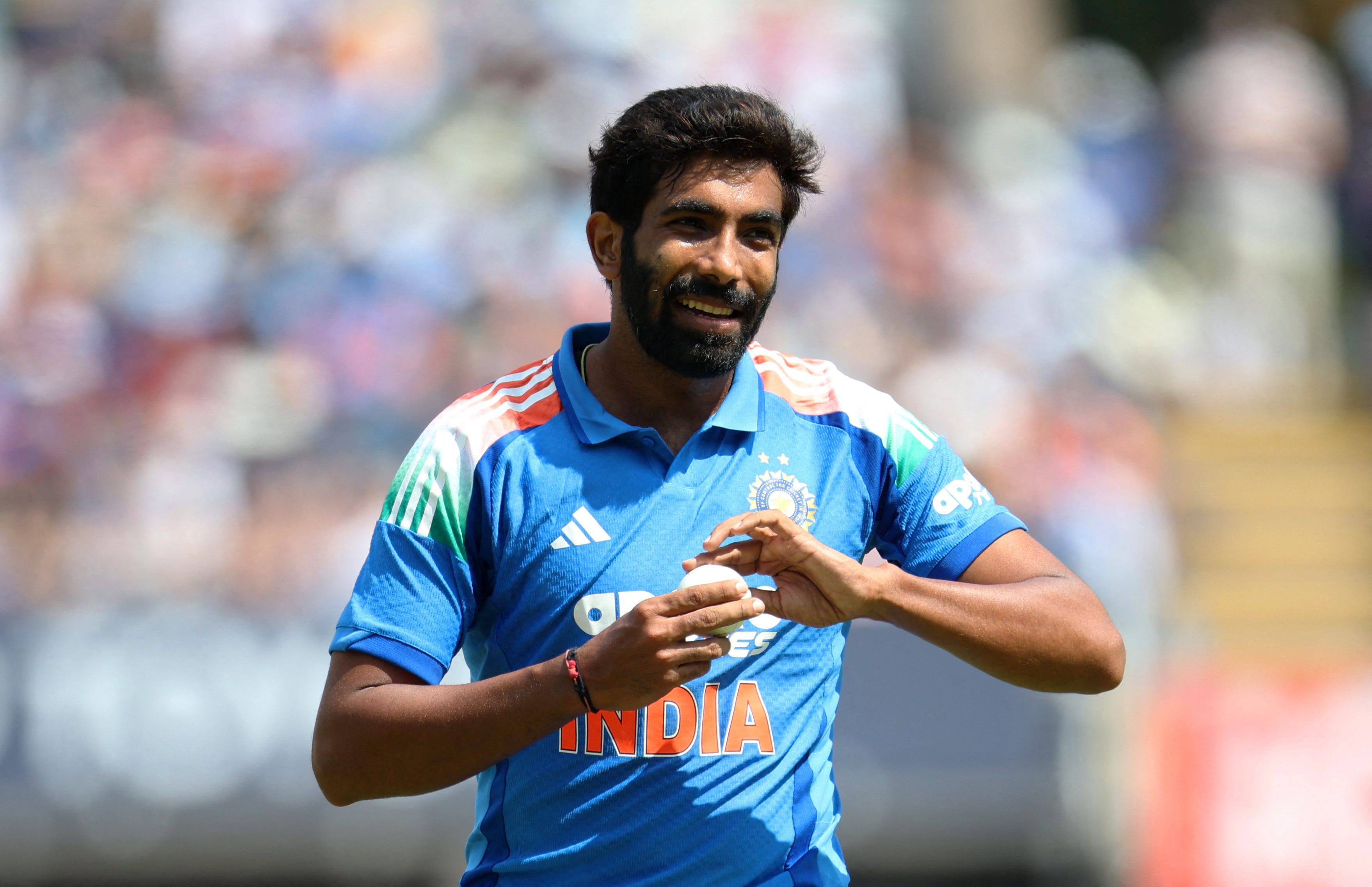
Jasprit Bumrah’s latest injury did not arrive while he was sending down another punishing Test spell. It was an impact injury sustained while fielding during the second ODI against England in Cardiff. The initial diagnosis did not sound alarming. The BCCI reported reactive swelling in his left knee, which ruled him out of the series decider. Bumrah had bowled 19 overs across the first two ODIs, taking 2/76 at an economy rate of exactly 4.00.
Yet more than two weeks later, the discomfort remained. Bumrah could not secure final fitness clearance following rehabilitation at the BCCI Centre of Excellence and was withdrawn from India’s two-Test tour of Sri Lanka. Auqib Nabi replaced him in the squad.
The immediate temptation is to count another series lost to injury. Bumrah has already missed major tournaments, overseas Tests and entire IPL seasons during a career repeatedly interrupted by physical setbacks.
The more revealing data, however, lies in what has happened after those absences. Bumrah’s injury history contains both successful comebacks and one disastrous false start. Together, they offer India a clear warning: the length of his rehabilitation has rarely damaged his bowling. Returning before his body was ready has.
The comeback that went wrong
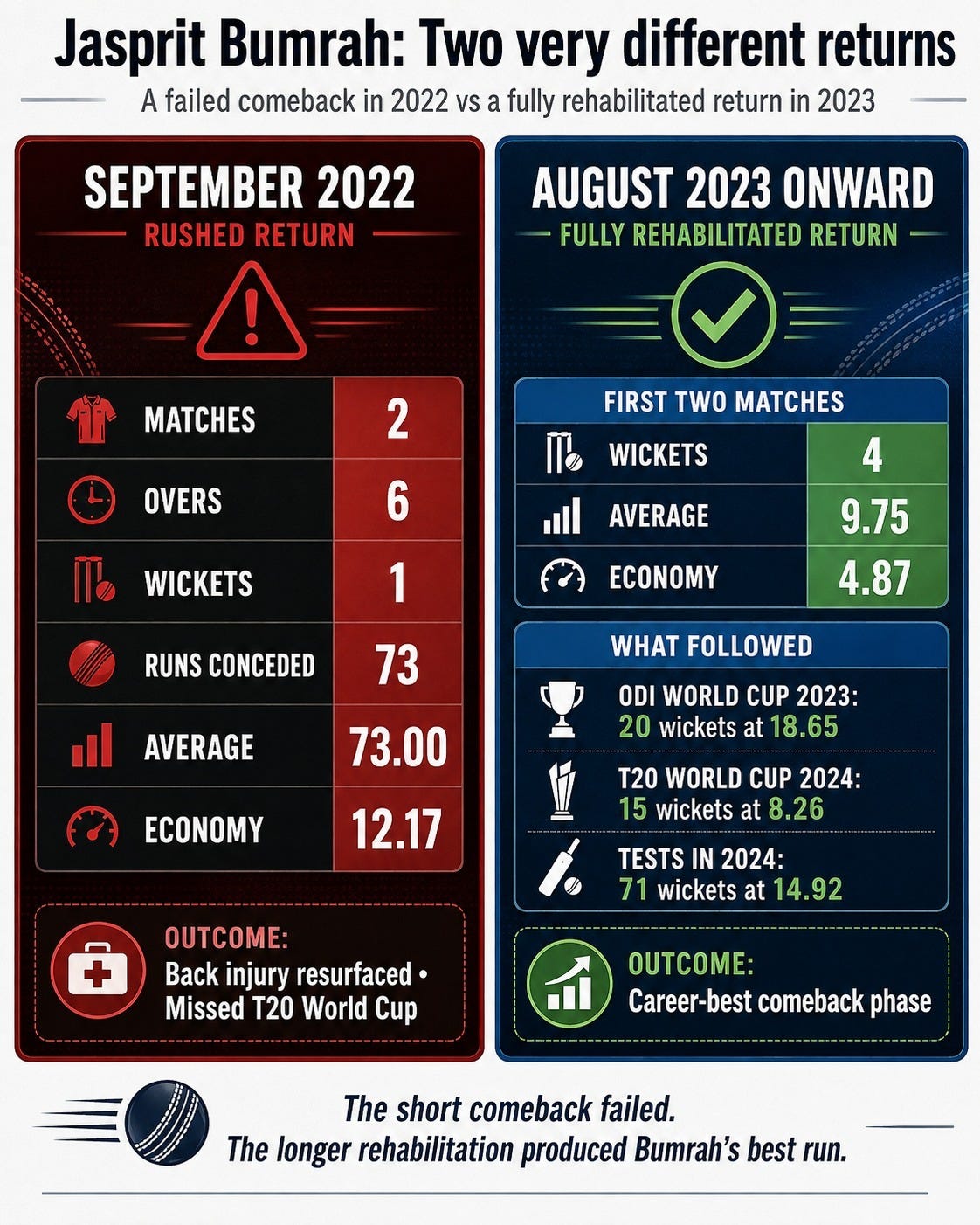
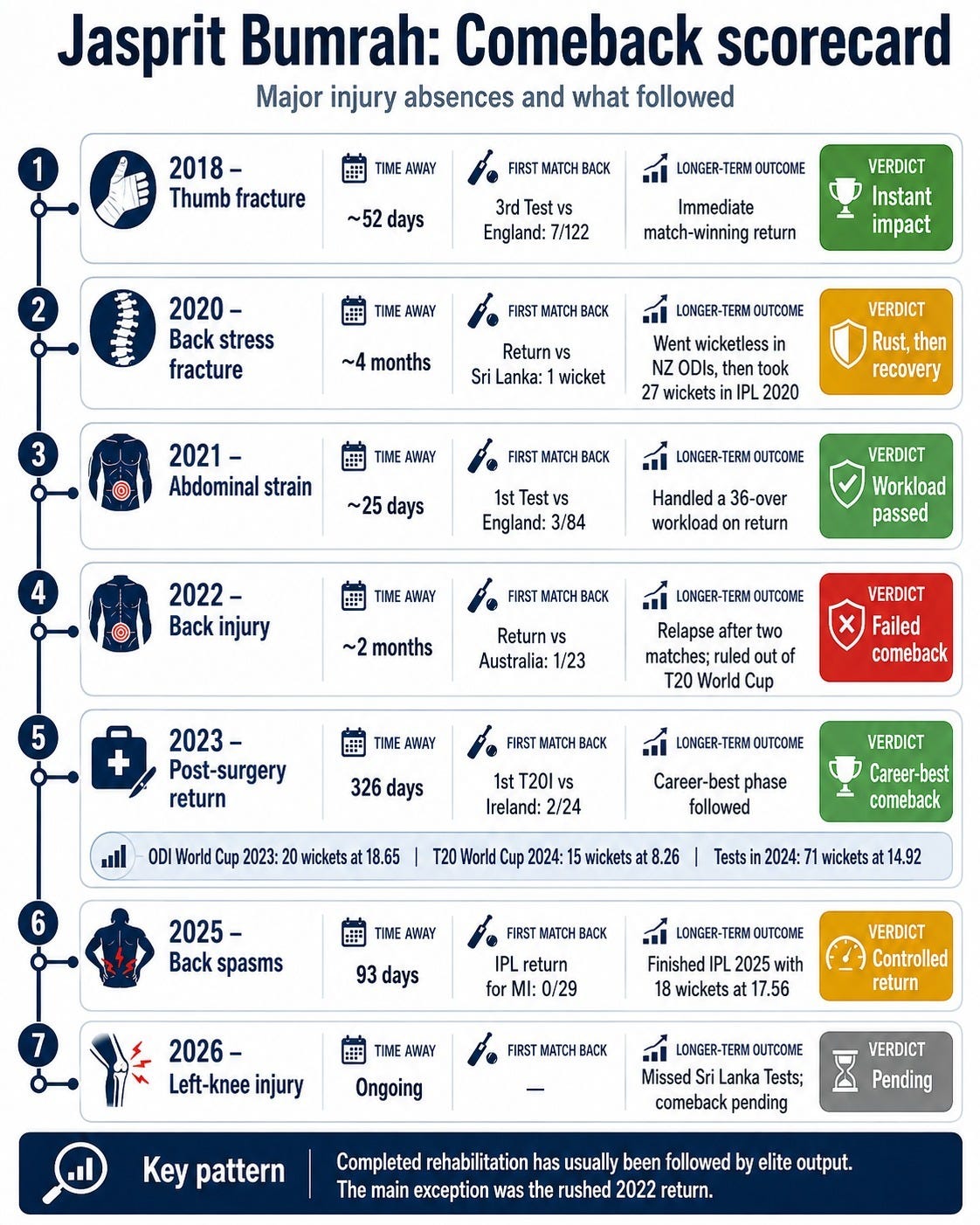
The defining example came in 2022. After suffering back spasms during the England tour, Bumrah missed the Asia Cup and spent nearly two months away from international cricket. He was brought back for the home T20I series against Australia as India attempted to prepare him for the T20 World Cup.
He played only two matches. His combined figures were 1/73 from six overs, producing an average of 73.00, an economy rate of 12.17 and a strike rate of 36 balls per wicket. He then experienced further back pain, missed the South Africa series and was ruled out of the World Cup.
India tried again in January 2023. Bumrah was added to the ODI squad against Sri Lanka after being declared fit, only to be withdrawn because his body required more time to develop “bowling resilience”. He eventually underwent back surgery in March.
That sequence remains the statistical trap India must avoid. The two-match comeback did not prove that Bumrah had lost his skill. It proved that passing an initial fitness assessment was not the same as being capable of repeatedly absorbing international bowling loads. The failed return cost him almost another year.
Longer rehabilitation, stronger Bumrah
When Bumrah finally returned against Ireland in August 2023, his numbers immediately looked different. He took 2/24 in his first match and 2/15 in his second. His series return was four wickets at 9.75, while conceding fewer than five runs per over. In his second game, he even delivered a wicket-maiden in the final over.
That was only the beginning. At the 2023 ODI World Cup, Bumrah claimed 20 wickets at an average of 18.65 and an economy rate of 4.06. At the 2024 T20 World Cup, he took 15 wickets at 8.26 while conceding only 4.17 runs per over, earning the Player of the Tournament award as India won the title.
His Test numbers were even more extreme. Bumrah took 71 wickets in 13 Tests during 2024 at an average of 14.92 and a strike rate of 30.1. The next-highest wicket-taker that year, Gus Atkinson, finished 19 wickets behind him. In Australia, Bumrah collected 32 wickets at 13.06 despite India losing the series.
The surgery did not return a reduced version of Bumrah. Statistically, it produced an even more destructive one. Before his August 2023 return, Bumrah had taken 128 wickets in 30 Tests—4.27 wickets per match. Since returning, he has added 106 wickets in 22 Tests—4.82 per match.
His wicket-taking rate per Test has therefore increased by approximately 13%.
The same improvement appears in T20Is. Before the comeback, Bumrah had 70 wickets from 60 matches, or 1.17 per appearance. He has since taken 51 in 35, increasing that rate to 1.46 wickets per match—an improvement of nearly 25%. The calculations are based on his pre-return record and current official career totals of 234 Test, 151 ODI and 121 T20I wickets.
Even his slower returns have worked. Not every comeback has delivered instant wickets.
Following a lower-back stress fracture in 2019, Bumrah went wicketless across all three ODIs in New Zealand. The absence initially appeared to have disrupted his rhythm. Later that year, however, he took 27 wickets in IPL 2020.
After the back problem suffered in Sydney in January 2025, Bumrah spent 93 days without competitive cricket. He returned with 0/29 from four overs for the Mumbai Indians, but finished IPL 2025 with 18 wickets at 17.56 and an economy rate of 6.68. He then took 14 wickets in three Tests in England, including two five-wicket hauls.
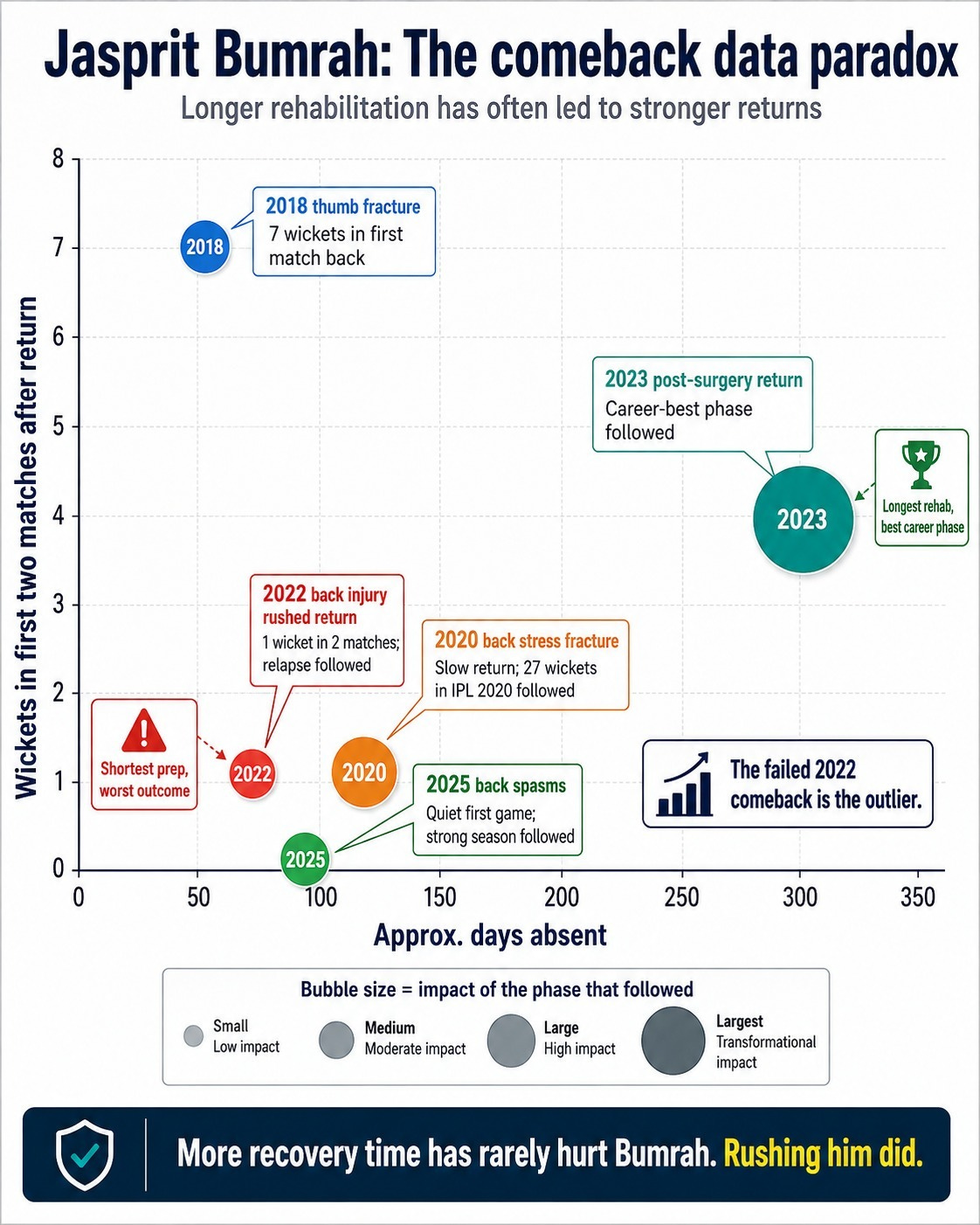
The trend is consistent. Bumrah does not always dominate in his first match back, but completed rehabilitation has generally been followed by elite output. The 2018 thumb fracture provided the most dramatic immediate return: 7/122 in the Trent Bridge Test, including 5/85 in the second innings, as India won by 203 runs.
The 2019 return required competitive overs. The 2023 return produced the finest sustained phase of his career. The 2025 return began quietly before developing into another productive season.
Only the rushed 2022 comeback ended in an immediate relapse. That is why the current decision matters. The knee problem is different from the recurring lower-back injury that required surgery, and it originated from an impact while fielding rather than accumulated bowling stress. But persistent discomfort is itself meaningful data.
India are not merely protecting Bumrah from missing two Tests in Sri Lanka. They are protecting the bowler who currently owns 234 Test wickets at 19.79 and has taken almost half of those wickets since returning from major back surgery. The real data trap would be measuring the cost of the matches Bumrah misses now while ignoring the far greater cost of bringing him back one match too early.
This is probably the strongest case for patience I've read.
Our overtly over-reliance, and super large focus on individuals in cricketers who are so injury prone that there is more reporting on their injuries than on their performance! This makes them larger than life heroes to the exclusion of so much talent there must be in this big country. .... and over forcus and over sponsorship of cricket has completely neglected the other more widespread and thrilling sport, football. Its a pity that India is lagging far behind in the soccer world .... though we saw some presence in the Expert Comemtaotors Box at the FIFI WC 2026 ....